
Why moisture matters
Wet grains stick together and form lumps. This makes it harder for material to pass through screens and reduces the accuracy of particle-size separation.
Dryness also matters during storage and use. In dry mixes, coatings and polymer systems, excess moisture may affect the formulation and repeatability of the result.
How rotary drying works
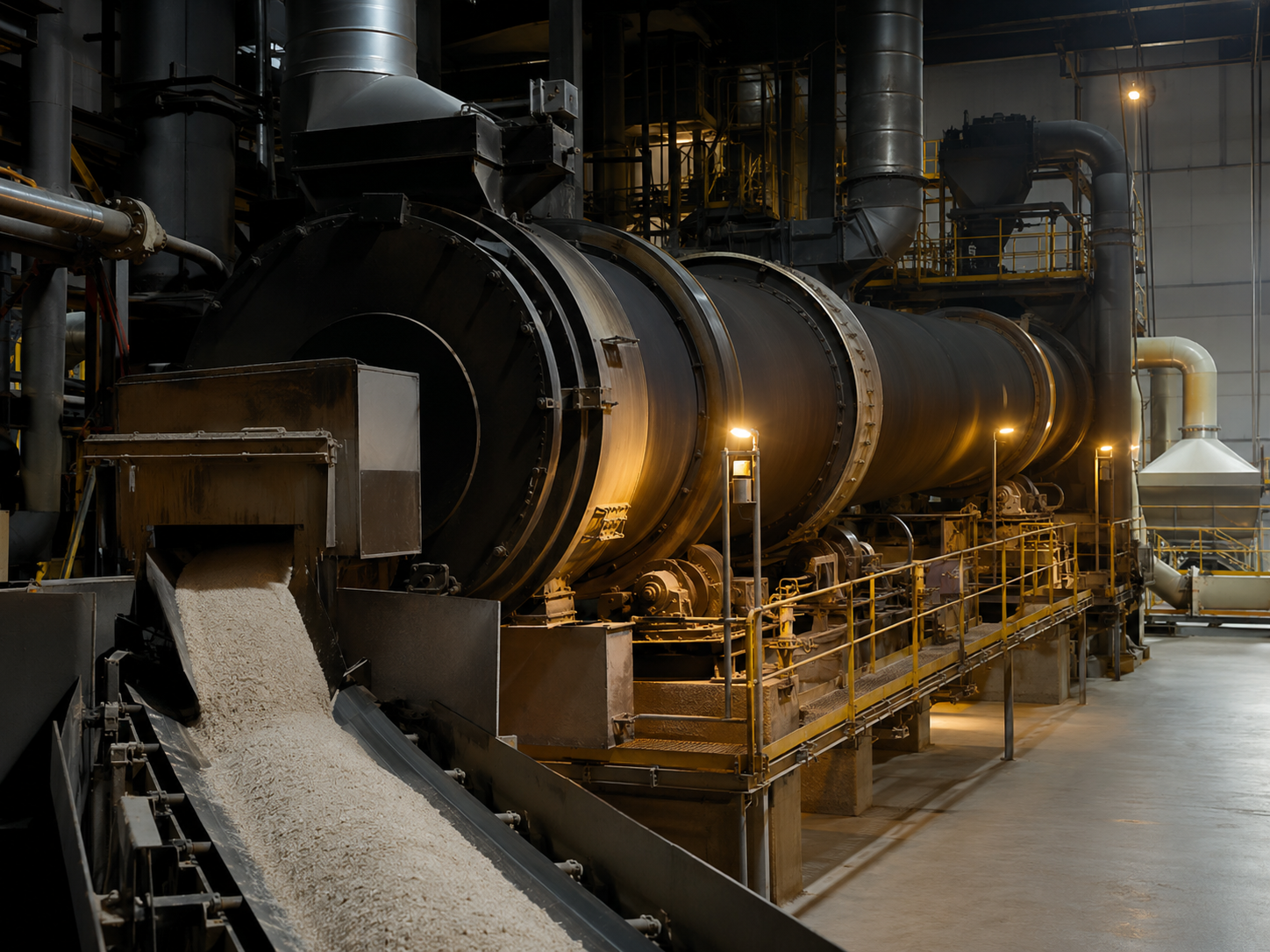
Washed material is fed evenly into a rotary dryer. As the drum turns, the sand remains in motion and meets a flow of heated air, allowing moisture to evaporate progressively.
Natural gas is used as the heat source. The production line is operated so that the material dries evenly and remains suitable for the next processing stage.
- consistent feed of washed material;
- stable thermal conditions;
- free-flowing sand at the dryer outlet;
- readiness to pass through the screens.
Preparing for accurate separation
After drying, individual grains should move freely without sticking together. In this condition, sand can be consistently separated into specified particle-size ranges.
The dry material is transferred to the fractionation line, where the bulk sand is divided into individual commercial fractions.